
Example: a complaints head at a payment firm counts 40 open complaints on a Monday morning. Three were logged late, two have no reply date, and one customer is asking, for the second time, where they can escalate. None of that is a hard legal question. It is a missing clock and a missing record.
Good complaint handling at a regulated firm comes down to three things: register every complaint, reply inside the deadline that applies to it, and tell the customer where to go next. The deadline depends on the complaint: PSD2 Article 101(2) sets 15 business days for payment-service complaints only, and we found no single EU deadline for consumer credit. An AI agent can do most of the paperwork: register, classify, assemble the file, show the deadline and draft the reply. A named complaints handler should decide every outcome and send every reply.
In short
- There is no single EU complaint deadline. For payment services, PSD2 Article 101(2) sets 15 business days, and 35 in exceptional cases with a holding reply. For consumer credit, CCD2 Article 40 asks for access to out-of-court dispute resolution. Your national rules fill in the rest.
- The ESAs’ complaints guidelines are addressed to supervisors, and through them reach banks, payment and e-money institutions, and some mortgage-credit firms.
- An agent drafts, a person decides. Every outcome, offer and refusal stays with a named handler.
- Never point the agent at your staff. Scoring staff performance is a high-risk use under the AI Act, and reading staff emotions at work is prohibited. Score the agent’s drafts instead.
We read every article cited here on 14 November 2026. This is an engineer’s reading, not legal advice. Your counsel or DPO should confirm it against your national rules.
Which complaint handling deadline applies to you?
It depends on what the complaint is about. A payment-service complaint has an EU deadline; a consumer-credit complaint, in the texts we read, does not have one EU-wide reply deadline.
For payment services, PSD2 Article 101(2) says the reply “shall address all points raised, within an adequate timeframe and at the latest within 15 business days of receipt of the complaint”. If an answer cannot be given in time for reasons beyond the provider’s control, it sends a holding reply with the reason and a date. The final reply comes within 35 business days at most.
That article covers complaints under Titles III and IV of PSD2, the payment-service rules. It is not a rule for consumer credit in general. We read PSD2 as published on legislation.gov.uk; ask counsel to check for later EU amendments.
For consumer credit, Member States apply their national CCD2 measures from 20 November 2026 (Article 48(1)). Article 40(1) asks Member States to give consumers access to “adequate, prompt and effective out-of-court dispute resolution procedures” with creditors and credit intermediaries. Any reply deadline for the lender itself comes from national law, which counsel must check.
| Rule | Who it reaches | What it says about complaints | What it does not settle |
|---|---|---|---|
| PSD2 Art. 101 | Payment service providers, for payment-service complaints | Make every possible effort to reply on paper or an agreed durable medium; 15 business days; up to 35 with a holding reply in exceptional situations beyond the provider’s control; name at least one competent ADR entity | Complaints about credit, insurance or investments |
| CCD2 Art. 40 | Consumers’ access to dispute resolution with creditors and credit intermediaries | Member States ensure adequate, prompt and effective out-of-court dispute resolution | National reply rules: check with counsel |
| CCD2 Art. 21, 22 | Creditors | The agreement states the out-of-court complaint route; a change of terms states the means for complaint, the time to complain and the competent authority | National reply rules: check with counsel |
| JC guidelines (JC 2018 35) | National supervisors, and through them the firms they supervise | Complaints policy and function, registration, reporting, assessment and responses | Consumer-credit lenders under CCD2 are not named in their scope |
| Your national rule | Depends on the country | Whatever national law adds, including reply rules | Needs counsel, per country |
National rules can be stricter. PSD2 itself lets Member States keep dispute rules that are “more advantageous to the payment service user”, and says those rules then apply. So the deadline your agent shows should always name its source, and counsel should own that table.
Who do the EU complaints guidelines reach?
The Joint Committee of the European Supervisory Authorities publishes guidelines on complaints handling. They are addressed to national authorities that supervise complaints handling by firms, which in banking include credit institutions, payment institutions and electronic money institutions. They cover the firm’s complaints policy and function, registration, reporting to the supervisor, and the assessment of and response to each complaint.
From 1 May 2019 the scope reached supervisors of two more groups under the Mortgage Credit Directive: credit intermediaries and non-credit institution creditors. The EBA states the aim as “a single set of complaints handling arrangements” across product types. Consumer-credit lenders under CCD2 are not named in that scope. If you are one, ask your supervisor and counsel what applies. We still find the guidelines’ structure a clear one to design a desk around.
How does a complaint move through the flow?
Here is the flow we design for, step by step. The agent handles steps 2 to 6 and groups themes at step 10. A person decides, sends and closes.
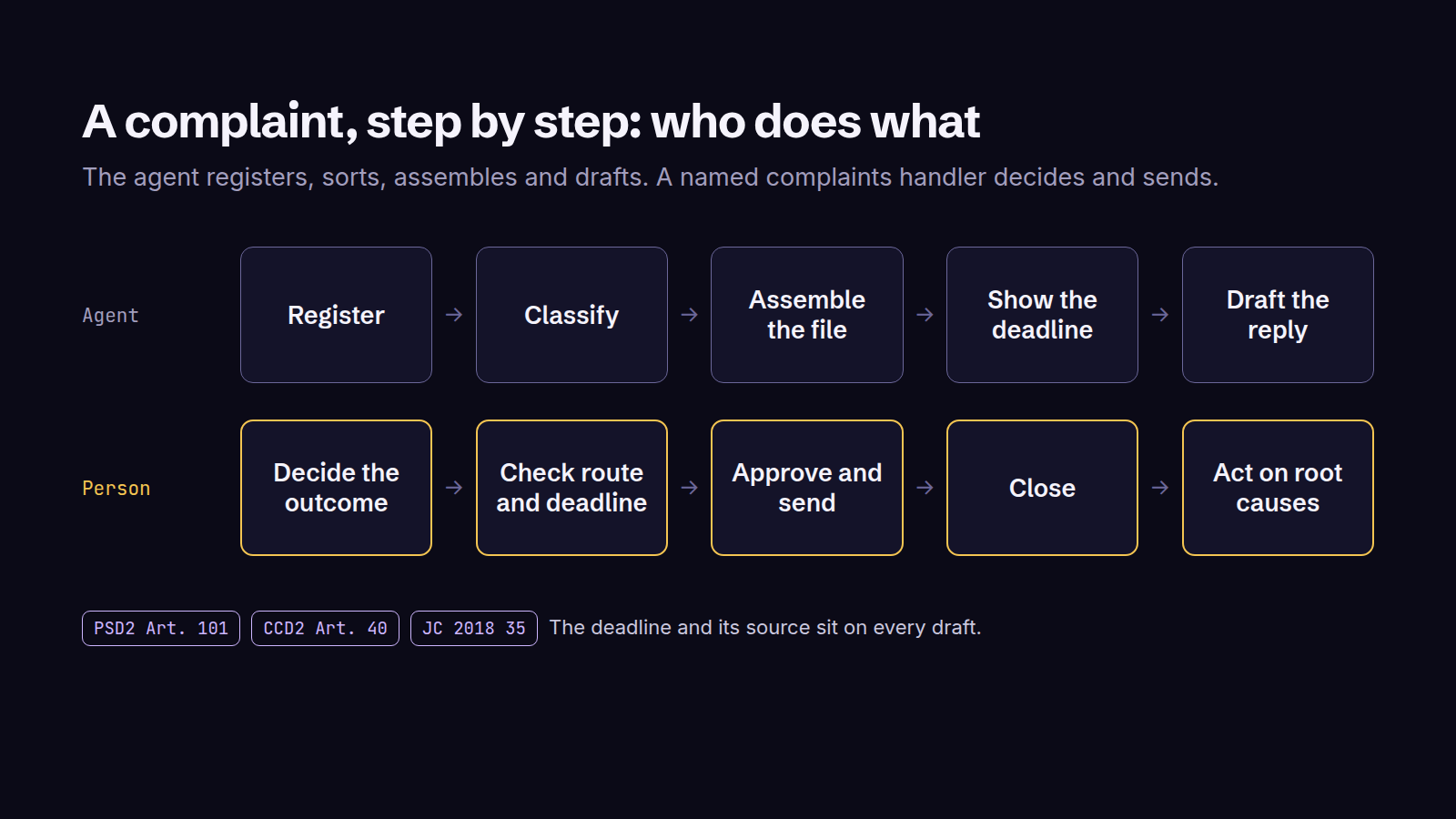
The agent prepares the file and the draft; a named complaints handler decides and sends.
- Received. A complaint arrives by email, form, chat or letter.
- Registered. The agent logs it with the channel and the date received.
- Classified. The agent tags the product, the issue and the rule that applies (PSD2, credit, insurance).
- File assembled. The agent pulls the account history, earlier contacts and the documents the handler will need.
- Deadline shown. The agent puts the reply date and its source on the draft, and warns before it is near.
- Reply drafted. Plain words, every point the customer raised answered, and the dispute route named.
- Person decides. A named handler decides the outcome and edits the draft.
- Sent. The handler approves and sends. For payment-service complaints, PSD2 asks the provider to make every possible effort to reply on paper or an agreed durable medium.
- Closed. The record shows who decided and when it was sent.
- Root cause. The agent groups themes across complaints; people decide what to fix.
PSD2 also asks that the procedures be available in an official language of the Member State concerned, or another language agreed with the customer. That is easy for an agent to check on every draft.
What does the agent do, and what does a person decide?
The agent does the reading, sorting and drafting. A person makes every decision the customer will feel.
| The agent | A named person |
|---|---|
| Registers each complaint and its channel | Decides whether the complaint is upheld |
| Classifies the product, issue and rule | Decides any refund, offer or goodwill payment |
| Assembles the file | Decides every refusal |
| Shows the deadline and its source | Decides when a holding reply is justified |
| Drafts the reply, naming the dispute route | Approves and sends the reply |
| Groups themes across complaints | Decides which root causes to fix |
We would not let an agent send a complaint reply on its own. A reply is the firm’s position, and the customer may take it to the dispute route it names. Designing that approval step well is its own subject; we cover it in designing the approval step an auditor will accept.
This is the design we build to at Wise Agents: the agent drafts, a person decides, and every run is recorded. Here are four checks we recommend running on every draft from a complaints agent.
| Check | Passes when | Fails when |
|---|---|---|
| Deadline line | The draft shows the reply date and its source | The date or the source is missing |
| Every point answered | Each point the customer raised has an answer | One point is skipped |
| Dispute route | The reply names where the customer can escalate | No route is named |
| Holding reply | It gives the reason for the delay and the date of the final reply | The reason or the date is missing |
Example of a deadline line on a draft: “Reply due: (date). Source: PSD2 Art. 101(2), read 14 Nov 2026.”
Can you use the complaints data for root-cause analysis?
Yes. The agent can only group complaints that were classified the same way. Once they are, it shows which product and issue themes are growing.
People then decide what to change: a confusing letter, a fee that surprises customers, a broken form. Complaint files hold personal data, so the same GDPR questions apply as for any agent. We list them in the seven questions your DPO will ask.
What must the agent never score?
Never your staff. The complaints desk is full of staff conversations, and it is tempting to grade them. Two AI Act rules make that a bad idea.
Annex III point 4(b) lists AI systems used “to monitor and evaluate the performance and behaviour of persons in such relationships” (work-related relationships) as high-risk. The same point covers systems that allocate tasks based on individual behavior or personal traits. Article 5(1)(f) prohibits using AI to infer the emotions of a person in the workplace, except for medical or safety reasons. How the risk classes work, and who carries which duty, is in the EU AI Act for companies deploying AI agents.
So score the agent’s own drafts, not people. Did the draft answer every point? Did it show the right deadline? Did it name the dispute route? Those are tests of the agent, and they belong in its pass bar.
What should the record of each complaint show?
Copy this list into your complaints procedure. Each line is a field in the record.
- Date and time received, and the channel.
- Date registered.
- The reply deadline, and the rule or national source it comes from.
- The classification: product, issue, rule.
- Whether a holding reply was sent, when, and the reason given.
- The agent’s draft, kept as drafted.
- Who decided the outcome, and what they decided.
- The final reply as sent, the date sent and the medium.
- The dispute route named in the reply.
- The date closed, and the root-cause theme.
Fields 6 and 7 show what the agent wrote and what the person changed. Without them, nobody can show that later.
FAQ
Is there one EU deadline for complaint handling?
No. PSD2 Article 101(2) sets 15 business days, or up to 35 with a holding reply, but only for payment-service complaints. For consumer credit, CCD2 Article 40 asks for access to out-of-court dispute resolution. National rules set the rest, so check each country with counsel.
Do the EBA complaints guidelines apply to consumer lenders?
The Joint Committee guidelines are addressed to national supervisors. Their scope reaches credit institutions, payment and e-money institutions, and, since 1 May 2019, credit intermediaries and non-credit institution creditors under the Mortgage Credit Directive. Consumer-credit lenders under CCD2 are not named, so ask your supervisor what it expects.
Can an AI agent answer customer complaints?
It can draft the answer, register the complaint, assemble the file and show the deadline. In the design we recommend, a named complaints handler decides every outcome and sends every reply. That keeps the firm’s position with a person.
Can we use AI to score our complaints staff?
We would not. Under the AI Act, systems that monitor and evaluate the performance and behavior of workers are high-risk (Annex III point 4(b)), and inferring emotions in the workplace is prohibited (Article 5(1)(f)). Score the agent’s drafts instead.
Complaint handling is one process, and we design it as one agent with a named person who decides, in finance and other regulated sectors. Bring one process. In 45 minutes you get a first view of its risk class, the controls it needs and whether an agent is the right tool at all. Book a scoping call.
Sources
- www.legislation.gov.ukwww.legislation.gov.uk/eudr/2015/2366/article/101
- eur-lex.europa.eueur-lex.europa.eu/eli/dir/2023/2225/oj/eng
- www.eba.europa.euwww.eba.europa.eu/publications-and-media/press-releases/eba-updates-joint-committee-guidelines-complaints-handling
- www.eba.europa.euwww.eba.europa.eu/regulation-and-policy/consumer-protection-and-financial-innovation/guidelines-for-complaints-handling-for-the-securities-esma-and-banking-eba-sectors
- artificialintelligenceact.euartificialintelligenceact.eu/annex/3/
- artificialintelligenceact.euartificialintelligenceact.eu/article/5/
Read on or before 14 November 2026. Not legal advice: your counsel and data protection officer decide.
Related posts

AI Act high risk insurance and banking: which AI is listed?
AI Act high risk insurance and banking rules, process by process: what Annex III lists, what it leaves out, and the date your team should plan against.
Read
AI Agent Audit Logs: What to Record and How Long to Keep It
AI agent audit logs: the fields to record for every run, what AI Act Articles 12, 19 and 26(6) and GDPR say about keeping them, and a review routine.
Read
AI Literacy Training: What Article 4 Asks, and a Staff Plan
AI literacy under Article 4 now means supporting it, not guaranteeing it. What changed, who enforces it, and a training plan by role for 200 people.
Read