
Example: a head of credit operations at a consumer lender wants an AI agent on the loan queue. The DPO’s first question is short: “Is the agent deciding loans? Because Article 22 says it can’t.” The DPO is right that a fully automated refusal is restricted. The head of credit is right that most of the file can be automated. The real question is where the line falls.
The short answer: Article 22(1) of the EU GDPR bans, in principle, a loan decision based solely on automated processing, and Article 22(2) allows three narrow exceptions with safeguards. We recommend a simpler design. An AI agent does most of the work on a loan file: it collects documents, checks them, extracts the figures, flags fraud signals, drafts the letters and keeps the record. A person who can really change the outcome decides whether to grant or refuse the loan. Be careful with “the person only signs”: in SCHUFA, the EU’s top court held that a credit score that plays a determining role in granting credit is itself the decision.
In short
- Article 22(1) is a prohibition in principle. A loan refusal based solely on automated processing is covered, and the applicant does not have to object first.
- A rubber stamp may not help. In SCHUFA, the Court held that a credit score that plays a determining role in the lending decision is itself a decision under Article 22. In our reading, the same can hold for an agent’s score that a person always follows.
- Creditworthiness AI is high-risk under the AI Act (Annex III point 5(b)) from 2 December 2027, with deployer duties for oversight staff and logs.
- Six of the eight steps below can be run or prepared by an agent. The offer-or-refusal decision and the review of a contested decision stay with a person.
We read every article and judgment cited here on 13 November 2026. GDPR came from gdpr-info.eu, the AI Act as amended by the Digital Omnibus on AI from artificialintelligenceact.eu, and the two judgments and the consumer credit directive from EUR-Lex. This is an engineer’s reading, not legal advice. Your counsel and your DPO should confirm it for your lender and your country.
What does Article 22 GDPR actually say?
Article 22(1) gives a person the right not to be subject to a decision based solely on automated processing, including profiling, which produces legal effects or similarly significantly affects them. A refused loan fits that last part easily.
The Court of Justice spelled out the test in SCHUFA (C-634/21, 7 December 2023). Three conditions must all be met:
- There is a decision.
- It is based solely on automated processing, including profiling.
- It has legal or similarly significant effects on the person.
The same judgment says Article 22(1) “lays down a prohibition in principle”, whose infringement does not need to be invoked by the person. So it is not a right the applicant must claim. The lender has to design for it from the start.
When is an automated decision allowed?
Article 22(2) lists three exceptions. The ban does not apply where the decision:
- is necessary for entering into, or performing, a contract with the person (point a);
- is authorized by Union or Member State law that sets suitable safeguards (point b);
- rests on the person’s explicit consent (point c).
For the contract and consent cases, Article 22(3) sets a floor: the controller must offer at least the right to obtain human intervention, to express a point of view and to contest the decision. Article 22(4) adds that these decisions may not be based on special categories of personal data (health, ethnic origin and the rest of Article 9(1)) unless Article 9(2)(a) or (g) applies with safeguards.
So Article 22 does not make a fully automated credit decision impossible. It makes it a regulated design, with a human route built in either way. For most lenders we think the cleaner design is the one below: the agent prepares, a person decides.
Why is “a person clicks OK” not enough?
Because a score can count as the decision even when someone else signs. In SCHUFA, a credit agency sent a probability value to a bank. The Court held that where that value plays a determining role in the granting of credit, establishing it “must be qualified in itself as a decision” under Article 22(1).
SCHUFA was about a third-party credit agency’s score. In our reading, the same logic is likely to apply to your own agent’s score or recommendation: if the loan officer follows it every time, it is doing the deciding. Your counsel should confirm that reading for your setup.
The AI Act names the same trap. Article 14(4)(b) asks that the people overseeing a high-risk system are enabled to remain aware of the possible tendency of automatically relying or over-relying on its output: automation bias.
Here is a self-test we suggest. It is our own inference, not a legal threshold. Compare how often the person’s final decision differs from the agent’s recommendation. If it almost never does, ask why: is the agent very good, or is the person not really looking? Check whether the person sees the underlying documents, has time to read them and has the authority to overrule. If not, the person’s step probably adds nothing, and the agent’s output is the decision.
For how to build the approval step itself, see human oversight in practice.
What may the agent do at each step of the loan?
Eight steps, from the application arriving to the file being closed. Who decides is the split we recommend; your counsel and DPO decide the final version for your process.
- Intake and document checks. The agent collects the application and documents and checks they are readable and the right type. Agent runs it. Rules to check: GDPR basics (lawful basis, data minimization).
- Completeness and data extraction. The agent extracts income, outgoings and existing debts, lists what is missing and asks the applicant for it. Agent runs it, a person spot-checks. Rules to check: GDPR accuracy.
- Identity and fraud signals. The agent flags mismatches and fraud signals for a person. Agent prepares, a person decides on any flag that stops the file. Rules to check: fraud detection is outside Annex III 5(b); GDPR still applies.
- Creditworthiness assessment. The agent prepares a summary of the file and, if a model is used, its score with the main factors. Agent prepares, a person assesses. Rules to check: AI Act Annex III 5(b); SCHUFA; CCD2 Art. 18(8).
- Offer or refusal. Nothing beyond the prepared file. A person decides. Rules to check: GDPR Art. 22(1).
- Customer message and explanation. The agent drafts the offer or the refusal letter from the recorded decision. Agent drafts, a person sends. Rules to check: GDPR Art. 15(1)(h); AI Act Art. 86.
- Complaint and review. The agent registers the request and assembles the file and the applicant’s point of view. A person reviews and decides. Rules to check: GDPR Art. 22(3); CCD2 Art. 18(8).
- Monitoring and logs. The agent records every run and reports how often people change its recommendations. Agent runs it, a named person reads the report. Rules to check: AI Act Art. 26(2), 26(6); GDPR Art. 35.
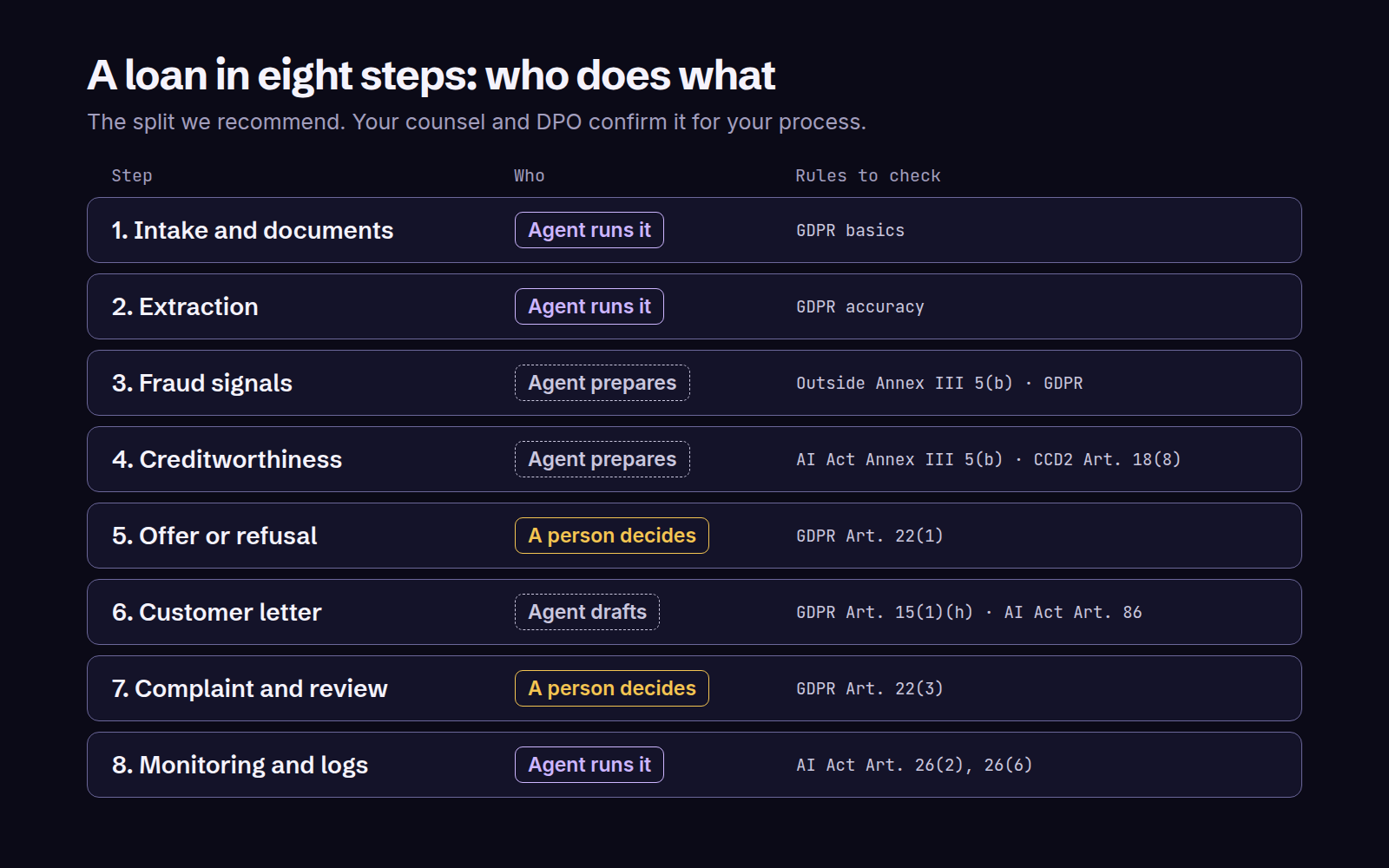
Steps 1, 2 and 8 the agent runs; steps 3 and 4 it prepares; step 6 it drafts; steps 5 and 7 a person decides, with the rules to check on each row. Drawn for this post.
Steps 1 and 2: the agent does the work
Intake and extraction are not decisions about the applicant, so an agent can run them. Checking that a payslip is a payslip, reading the figures and asking for a missing bank statement still process personal data, so the usual GDPR questions apply: lawful basis, minimization, sub-processors. Those are covered in the seven questions your DPO will ask.
Step 3: fraud signals
Annex III point 5(b) of the AI Act lists AI systems that evaluate creditworthiness or establish a credit score, “with the exception of AI systems used for the purpose of detecting financial fraud”. So a fraud-flagging step is not high-risk under that point. GDPR does not have that exception. If a fraud flag alone would end an application, we would have a person look at it first.
Steps 4 and 5: the decision
This is where both laws meet. A model that scores creditworthiness is high-risk under the AI Act. Under SCHUFA, its score is a decision if it determines the outcome. The consumer credit directive adds its own route: where the creditworthiness assessment involves automated processing, the consumer has the right to request and obtain from the creditor human intervention (CCD2 Article 18(8)).
Our design keeps the agent on the preparing side. It assembles the file, shows the figures and their sources, and gives its recommendation with the reasons. A credit officer with the authority to decide either way makes the call, and the record shows what they saw.
Steps 6 and 7: the letter and the review
The agent drafts. A person sends anything that reports a decision and decides any review. Step 7 is where the Article 22(3) rights live: human intervention, the applicant’s point of view, and contesting the decision.
Step 8: the record
The self-test above needs two things side by side: what the agent recommended and what the person finally decided. Record both for every file. Under AI Act Article 26(6), the lender as deployer keeps the system’s logs under its control for at least six months, so plan where the person’s decision is stored from the start.
What does the AI Act add for the steps that touch creditworthiness?
The AI Act adds duties for the lender as deployer: the company that uses an AI system under its own authority. They apply to Annex III high-risk systems from 2 December 2027 (Article 113, as amended by the Digital Omnibus on AI).
- Oversight by people who can do it. Deployers assign human oversight to people who have the necessary competence, training and authority, as well as the necessary support (Article 26(2)).
- Logs. Deployers keep the logs the system generates, to the extent they are under their control, for at least six months unless other Union or national law says otherwise (Article 26(6)).
- An explanation on request. Take a decision a deployer bases on an Annex III high-risk system’s output, with legal or similarly significant effects. The person affected can ask for clear and meaningful explanations of the role of the AI system in the decision-making procedure and the main elements of the decision (Article 86).
GDPR asks for a data protection impact assessment before this kind of processing too. Article 35(3)(a) names a systematic and extensive evaluation of personal aspects based on automated processing, including profiling, on which decisions with legal or similarly significant effects are based. In our reading, credit scoring fits that description closely; your DPO makes the call. Which class your system falls into, and who is provider or deployer, is in the EU AI Act for companies deploying AI agents.
What must you be able to tell a refused applicant?
A short, plain explanation of how the decision was reached, not the model. Under GDPR Article 15(1)(h), a person can ask for meaningful information about the logic involved in automated decision-making. In Dun & Bradstreet Austria (C-203/22, 27 February 2025), the Court said the main purpose of that right is to let the person exercise their Article 22(3) rights: to express a point of view and to contest.
The Court was direct about what does not count. Sending “a complex mathematical formula, such as an algorithm”, or describing every step of the automated decision, is not a sufficiently concise and intelligible explanation.
That is a design requirement for step 4. If the agent’s file shows the main factors in plain words, the explanation at step 6 can be drafted from it. If the only record is a score, it cannot.
Is Article 22 about to change?
Not yet, and the current text is what applies. A Digital Omnibus proposal that would amend GDPR is in negotiation. On 21 October 2026 the Council’s ambassadors (Coreper) approved its negotiating mandate, and according to a Cuatrecasas note, “Article 22 is once again worded as a right to not to be subject to automated decisions”. It is a proposal in negotiation, not law. We would design to the current Article 22 and recheck when a final text is published.
Ask your counsel and DPO to confirm three things for your process. Which Article 22(2) exception, if any, do you rely on? Does your national law add rules on automated credit decisions? Is your credit model a high-risk system, with you as deployer?
How do we build a loan agent on the Wise Agents platform?
We build the agent for one process, the loan file, and we draw the line above into it from the start. The agent’s work stops at the prepared file and the drafted letter. The offer-or-refusal decision belongs to a named person at the lender, in the lender’s own process. We record every run, with what the agent saw and what it recommended, so the self-test starts from data that already exists once the lender records its final decision beside it.
Before anything goes live, the client signs a pass bar: the written list of tests the agent must pass, with the result each one needs. Every safety case on it must pass. Example: a test case where the agent’s file for a refused applicant lacks the plain-language reasons must fail. A named person approves each release. Every control is mapped to the article it answers, read on a stated date. More on how this works for lenders and other regulated sectors.
FAQ
Does Article 22 GDPR ban AI in lending?
No. It covers decisions based solely on automated processing with legal or similarly significant effects, such as a loan refusal. An AI agent can still collect, check and prepare the file. Even a fully automated decision is possible under the Article 22(2) exceptions, with the Article 22(3) safeguards.
Is a credit score a decision under Article 22?
It can be. In SCHUFA (C-634/21), the Court of Justice held that a score which plays a determining role in the granting of credit is itself a decision under Article 22(1). In our reading, a person who always follows the score does not change that, and counsel should confirm it for your process.
Is a credit scoring AI system high-risk under the AI Act?
Yes, if it is intended to evaluate the creditworthiness of natural persons or establish their credit score: Annex III point 5(b). Systems used to detect financial fraud are excluded. The high-risk rules for Annex III systems apply from 2 December 2027 (Article 113, as amended).
What explanation does a refused applicant get?
Under GDPR Article 15(1)(h), as read in Dun & Bradstreet (C-203/22), a concise and intelligible explanation of how the decision was reached, not a formula. Once the AI Act’s high-risk rules apply, Article 86 also gives a right to clear and meaningful explanations of the AI system’s role and the main elements of the decision.
How long must a lender keep the AI system’s logs?
Under AI Act Article 26(6), deployers keep the logs a high-risk system generates, under their control, for at least six months, unless other Union or national law sets something else. Ask counsel which period applies to your lender.
Take the eight steps to your DPO and mark each row with your own process. It is the page we would want to receive if we were the DPO. Bring one process. In 45 minutes you get a first view of its risk class, the controls it needs and whether an agent is the right tool at all. Book a scoping call.
Sources
- gdpr-info.eugdpr-info.eu/art-22-gdpr/
- eur-lex.europa.eueur-lex.europa.eu/legal-content/EN/TXT/?uri=CELEX:62021CJ0634
- eur-lex.europa.eueur-lex.europa.eu/legal-content/EN/TXT/?uri=CELEX:62022CJ0203
- artificialintelligenceact.euartificialintelligenceact.eu/annex/3/
- artificialintelligenceact.euartificialintelligenceact.eu/article/113/
- artificialintelligenceact.euartificialintelligenceact.eu/article/14/
- artificialintelligenceact.euartificialintelligenceact.eu/article/26/
- artificialintelligenceact.euartificialintelligenceact.eu/article/86/
- gdpr-info.eugdpr-info.eu/art-35-gdpr/
- gdpr-info.eugdpr-info.eu/art-15-gdpr/
- www.cuatrecasas.comwww.cuatrecasas.com/en/latam/intellectual-property/art/digital-omnibus-eu-council-establishes-position
- eur-lex.europa.eueur-lex.europa.eu/eli/dir/2023/2225/oj/eng
Read on or before 13 November 2026. Not legal advice: your counsel and data protection officer decide.
Related posts

AI Agent Audit Logs: What to Record and How Long to Keep It
AI agent audit logs: the fields to record for every run, what AI Act Articles 12, 19 and 26(6) and GDPR say about keeping them, and a review routine.
Read
GDPR AI Agent Data Processing Agreement: A Checklist
GDPR AI agent data processing agreement checklist: the Article 28(3) items, the sub-processor chain down to the model provider, transfers and ten questions.
Read
Shadow AI: How to Find It and a Usage Policy That Works
Shadow AI is staff using AI tools nobody approved. Find it in a week, sort what they paste by data class, keep a register and write a short policy.
Read